How Financial Advisors Get More Clients: 7 Proven Strategies (2026)

Bhavya Barot
Growing a financial advisory practice in 2026 is harder than it was a decade ago. Competition has intensified, prospects are harder to reach, and the traditional referral pipeline that built most RIA books of business is no longer enough on its own.
But advisors who are growing — consistently, predictably — are doing a few things differently. They're not relying on one channel. They're building systems. And they're putting themselves in front of the right people before those people are already talking to someone else.
This guide covers 7 strategies that are actually working for financial advisors right now, from refining your ideal client profile to building a multi-channel outreach system that books meetings without you manually chasing every lead.
Why most advisor growth stalls
Most advisors grow through referrals for the first several years. It works well — until it doesn't. The problems with a referral-only growth model:
- It's passive. You depend entirely on your existing clients to introduce you to new ones.
- It's unpredictable. Good months and dry months with no way to smooth the curve.
- It caps your market. Your network determines your ceiling.
The advisors who break through this ceiling add proactive outreach to their referral base — so they're generating new conversations in parallel, not waiting for the phone to ring.
Strategy 1: Define your ideal client with precision
The advisors who struggle to grow often have the same problem: they'll work with anyone. The advisors who grow fastest have a clear, specific answer to "who do you serve."
This matters for three reasons:
Your messaging lands harder. An advisor who says "I specialise in financial planning for surgeons in their 40s navigating income peaks and partnership decisions" is infinitely more compelling than one who says "I help people with their finances."
Your referrals improve. When existing clients know exactly who you're looking for, they refer better-fit people.
Your outreach scales. A specific ICP means you can build a targeted prospect list and run systematic outreach — rather than broadcasting generic messages to everyone.
How to define yours:
- What are the 5 characteristics of your best current clients? (profession, wealth tier, life stage, complexity of situation)
- What problems do you solve best?
- Who do you most enjoy working with?
The intersection of those three answers is your ideal client profile.
Strategy 2: Build a referral system, not a referral hope
Most advisors don't have a referral *system* — they have a referral *hope*. They do good work, they're likeable, and they occasionally get introduced to someone new.
A system is different:
Make it easy to refer. Give clients specific language. "If you know a CFO who's navigating a liquidity event and hasn't reviewed their wealth strategy in a while, I'd love an introduction" is far more actionable than "feel free to send people my way."
Ask at the right moments. The best time to ask for a referral is immediately after a client expresses appreciation — after a strong quarterly review, after you save them from a tax mistake, after you help them through a transition.
Create a referral loop with COIs. Your best referral partners are CPAs, estate attorneys, and family office administrators. Build genuine relationships with 3–5 who serve the same wealth tier as you. Refer to them, and they'll refer back.
Follow up on introductions fast. When someone refers you, respond within 24 hours. Slow follow-up makes referral partners stop sending them.
Strategy 3: Run proactive outreach to a defined prospect list
Referrals fill your pipeline sometimes. Outreach fills it consistently.
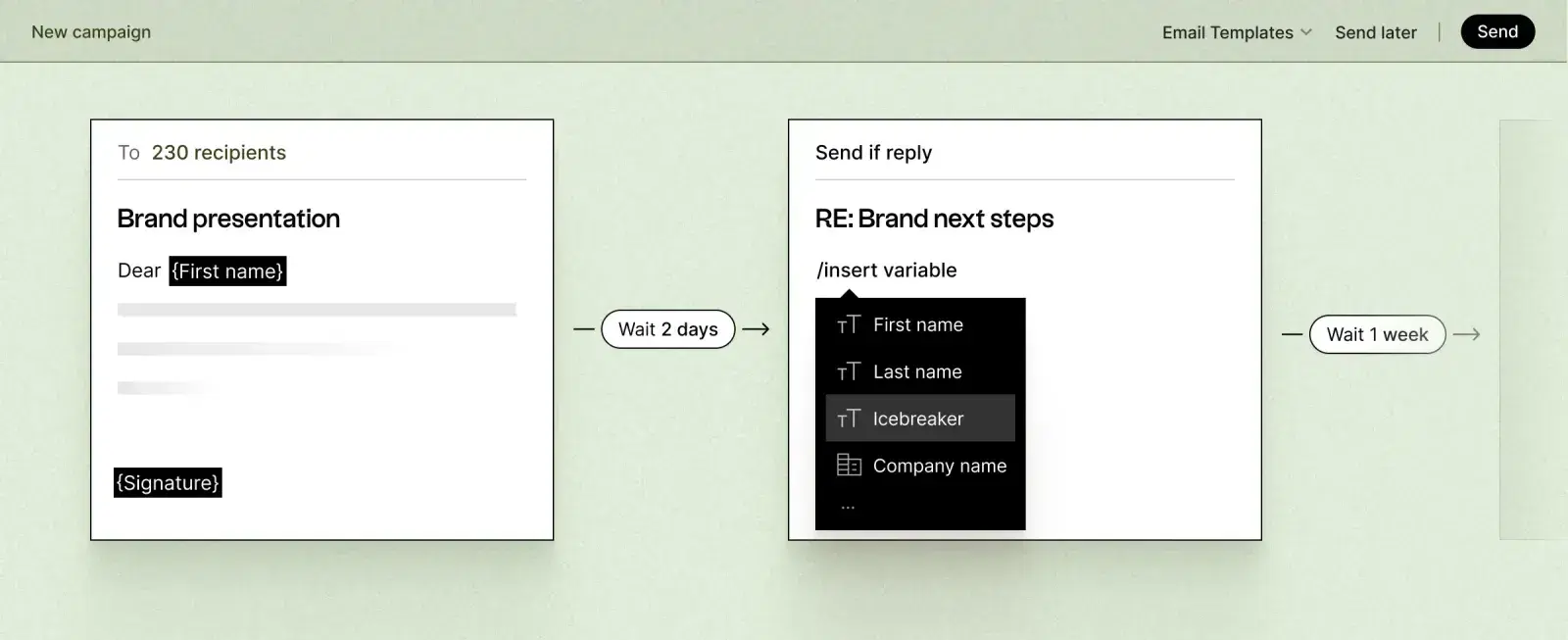
The advisors building the most predictable pipelines are running systematic, personalised outreach to a defined list of prospects — combining email and LinkedIn into a coordinated sequence that stays visible without being pushy.
What this looks like in practice:
- Build a prospect list based on your ICP (executives, business owners, high earners in a specific field)
- Research each prospect — recent news, role changes, LinkedIn activity
- Send a personalised first message that opens a conversation, not a pitch
- Follow up across channels (email + LinkedIn) over 2–3 weeks
- Qualified responses get moved into your sales process; the rest get a respectful close
The key is personalisation at the opening. A message that references something specific about the prospect gets 3–4x more responses than a template blast.
If you'd rather not manage this process in-house, Spaces runs it for you — building the list, writing the messages, and booking the meetings directly into your calendar.
Strategy 4: Use LinkedIn as a consistent presence, not a broadcast channel
LinkedIn is where your HNW prospects are. Executives, business owners, and senior professionals are on the platform daily — which makes it the best channel for warm, relationship-led outreach.
But most advisors use LinkedIn wrong. They either don't post at all, or they post company-branded content that reads like a press release and gets no engagement.
What actually works:
Consistent, personal content. 1–2 posts a week on topics your ideal clients care about: tax planning considerations, market context, decisions people in their situation face. Write in your voice, not your firm's.
Targeted connection requests. Connect with people who match your ICP — not everyone. A smaller, more targeted network is more valuable than a large, unfocused one.
Direct, non-salesy outreach. When someone's profile or post gives you a genuine reason to reach out, do it. Reference something specific. Ask a question. Don't pitch in the first message.
Engagement before outreach. Like and comment on a prospect's posts for a week or two before connecting. By the time you reach out, they already recognise your name.
Strategy 5: Niche down to stand out
Generalist advisors compete with everyone. Niche advisors compete with almost no one.
Some of the fastest-growing RIAs in recent years have built their entire practice around a specific vertical: tech employees navigating RSUs and equity compensation, physicians managing practice ownership transitions, federal employees with FERS/TSP complexity, business owners approaching exit.
Why niching works:
- You become the obvious specialist, not one of many options
- Word-of-mouth spreads faster within tight professional communities
- Your content, outreach, and referral asks all become more targeted and more compelling
- You can charge appropriately for genuine expertise
The objection most advisors have is "I'll lose clients." In practice, niching typically *adds* clients by making your value proposition sharper — while the clients you don't target simply wouldn't have been right-fit anyway.
Strategy 6: Build strategic COI partnerships
Centers of Influence — CPAs, estate attorneys, business bankers, HR benefits managers — are among the most reliable sources of qualified referrals for financial advisors. A single strong COI relationship can generate multiple introductions per year to well-qualified prospects.
How to build these relationships:
Give first. Refer your clients to them before expecting introductions back. Demonstrate that you're a reliable partner who sends business their way.
Educate, don't sell. Host informal lunches or roundtables for CPAs on financial planning topics relevant to their clients. Position yourself as a resource, not a vendor.
Be specific about who you want to meet. "Business owners with $3M–$10M in investable assets who are within 5 years of exit" is far more useful to a COI than "anyone you think I can help."
Stay top of mind. Send a brief note when you come across something relevant to their practice. Forward articles. Check in quarterly. COI relationships fade if you don't maintain them.
Strategy 7: Build a content and visibility engine
The advisors who get found — not just referred or outreached — have built some form of content presence that puts them in front of prospects who are actively looking.
This doesn't require a massive content operation. It requires consistency.
What works for advisors in 2026:
A LinkedIn content rhythm. 1–2 posts per week is enough to stay visible to your network. Focus on insights and perspective, not product descriptions.
A focused blog. Well-written posts on specific topics your prospects search for (tax planning for executives, equity compensation decisions, planning around a business sale) drive organic discovery and build credibility with prospects who find you.
A simple email newsletter. Monthly or quarterly. Real insights, your perspective, no fluff. Keeps warm relationships warm and reminds clients to refer you.
Guest content. Write for publications or podcasts your ideal clients consume. One byline in the right outlet reaches more of your ideal prospects than months of social posting.
The bar isn't perfection. It's showing up consistently with something genuine to say.
The compounding effect
The advisors who grow fastest aren't doing one of these strategies — they're doing several in parallel, and each one reinforces the others.
Outreach introduces you to new prospects. Content builds credibility so they say yes. Referral systems ensure happy clients are actively sending you introductions. COI relationships add a second pipeline. Niching makes all of it more efficient.
Start with the one strategy that feels most actionable given where you are today. Build it into a system. Then add the next layer.
If the outreach piece is where you want to start — or where you want to move faster — Spaces handles the prospecting, the personalised messaging, and the meeting booking so you can spend your time closing, not chasing.