How to Prospect High-Net-Worth Clients: The Advisor's Complete Guide (2026)

Bhavya Barot

Prospecting high-net-worth clients is fundamentally different from prospecting anyone else. The assets are larger, the decisions are more complex, the stakes are higher on both sides — and the people you're trying to reach are flooded with outreach from advisors who want their business.
What breaks through isn't louder or more frequent outreach. It's the combination of the right positioning, the right message, and the right channel — delivered with enough personalisation that the prospect feels understood rather than targeted.
This guide covers how to find, approach, and convert HNW prospects into clients: the psychology involved, the channels that work, the messaging that lands, and the mistakes that close doors permanently.
Understanding the HNW prospect
Before you can prospect HNW individuals effectively, you need to understand what makes their decision-making different.
They've heard it all before
An executive with $3M+ in investable assets receives advisor outreach constantly. They've heard every pitch, every "complimentary review" offer, every performance claim. Generic outreach doesn't just fail to work — it actively signals that you haven't done your homework and don't understand their situation.
They make decisions based on trust, not features
At this wealth level, most advisors can deliver technically competent advice. What differentiates the ones who win the relationship is trust: Does this person understand my situation specifically? Do they have relevant experience with people like me? Are they confident without being arrogant?
Trust isn't built in a single email. It's built through a sequence of interactions where you consistently demonstrate relevance and expertise.
They need a reason to move
HNW individuals often have an existing advisor relationship — even if they're not entirely satisfied with it. Inertia is powerful. For them to move, they need either a compelling reason to change (a new life event, a service failure, a significant gap in what they're receiving) or a referral-backed introduction that lowers the trust-building burden.
Your prospecting needs to either surface the gap or catch them at the right moment — which means consistency and patience matter as much as message quality.
Where to find HNW prospects
LinkedIn is the most accessible and scalable channel for reaching executives and business owners with significant wealth. Senior professionals are on the platform daily — which creates both the opportunity for content-led trust building and direct outreach.
Search filters let you identify prospects by title, company, industry, geography, and seniority. For advisors with a defined ICP, this is a goldmine of targetable, reachable prospects.
Professional networks and events
Industry conferences, executive networks, and professional associations are where HNW individuals go to meet people they trust. The relationship-building that happens at these events accelerates the trust timeline significantly compared to cold outreach.
The challenge is exclusivity — these events are expensive and time-consuming. But for advisors targeting a specific niche (tech executives, healthcare systems executives, family business owners), the right conference is worth the investment.
Referral networks
The most efficient path to HNW clients is still a warm introduction from someone they already trust. A referral from a CPA, estate attorney, or family friend moves a prospect from "cold" to "qualified and curious" in one step.
Building a systematic referral process — rather than hoping existing clients mention you — is one of the highest-return investments an advisor can make.
Family offices and institutional connections
For advisors targeting the ultra-HNW segment ($10M+), direct outreach rarely works. Relationships with family offices, trust companies, and wealth management gatekeepers become the relevant access point. These relationships take years to build but can produce significant referral flow once established.
Content and inbound
Advisors who consistently publish useful, specific content on LinkedIn or through a focused blog will eventually generate inbound interest from prospects who found them while researching a specific question. The volume is lower than outreach-driven pipelines, but the lead quality is high — these are people who already believe you know what you're talking about.
Building your prospect list
A targeted, well-researched prospect list is the foundation of effective HNW outreach. Blasting a large, unfocused list produces noise. A smaller list of well-qualified prospects with genuine fit produces conversations.
Define your ICP first
You need to know exactly who you're looking for before you build a list. The more specific, the better:
- Wealth tier and source: Executives with equity compensation? Business owners pre-exit? Individuals with inherited assets?
- Life stage: Accumulation, transition, or distribution phase?
- Geography: Local, regional, or national?
- Specific trigger events: Recent promotion, company IPO, liquidity event, retirement approaching?
The tighter your ICP, the more relevant your messaging — and the higher your response rate.
Building the list
For executives: LinkedIn Sales Navigator allows you to filter by title, seniority, company size, and geography with precision. Supplement with public information — press releases, executive team pages, conference speaker lists.
For business owners: Chamber of commerce directories, industry association member lists, and LinkedIn company searches by employee count and industry are all useful starting points.
Quality over quantity. A list of 200 well-qualified prospects with personalised outreach will outperform a list of 2,000 with generic messaging every time.
Crafting the message
What HNW prospects respond to
Specificity. A message that references something specific — their company, a recent announcement, a role change, a piece of content they published — immediately differentiates itself from the mass of generic outreach they receive.
Insight, not pitch. Instead of "here's what I do," offer an observation relevant to their situation: "For executives at companies approaching IPO, the equity decisions in the 18 months before the window opens are often the most consequential — and the least planned for."
Brevity. Senior executives do not read long emails. Five sentences that land a specific point outperform a five-paragraph essay every time.
No pressure. A soft ask — "would it be worth a 15-minute conversation?" or "happy to send some context on this if useful" — is far more effective than a demand for a 45-minute meeting with an attached calendar link.
The opening line
The first line of your email is everything. It needs to prove immediately that this isn't a mass message — that you know something about them specifically.
Weak opening: "I'm reaching out because I work with high-net-worth executives like yourself..."
Strong opening: "I saw that [company] announced [specific news] last week — for executives in your position, the next 12–18 months will likely involve some significant decisions."
The difference is not about being clever. It's about demonstrating that you've done the work to understand their context.
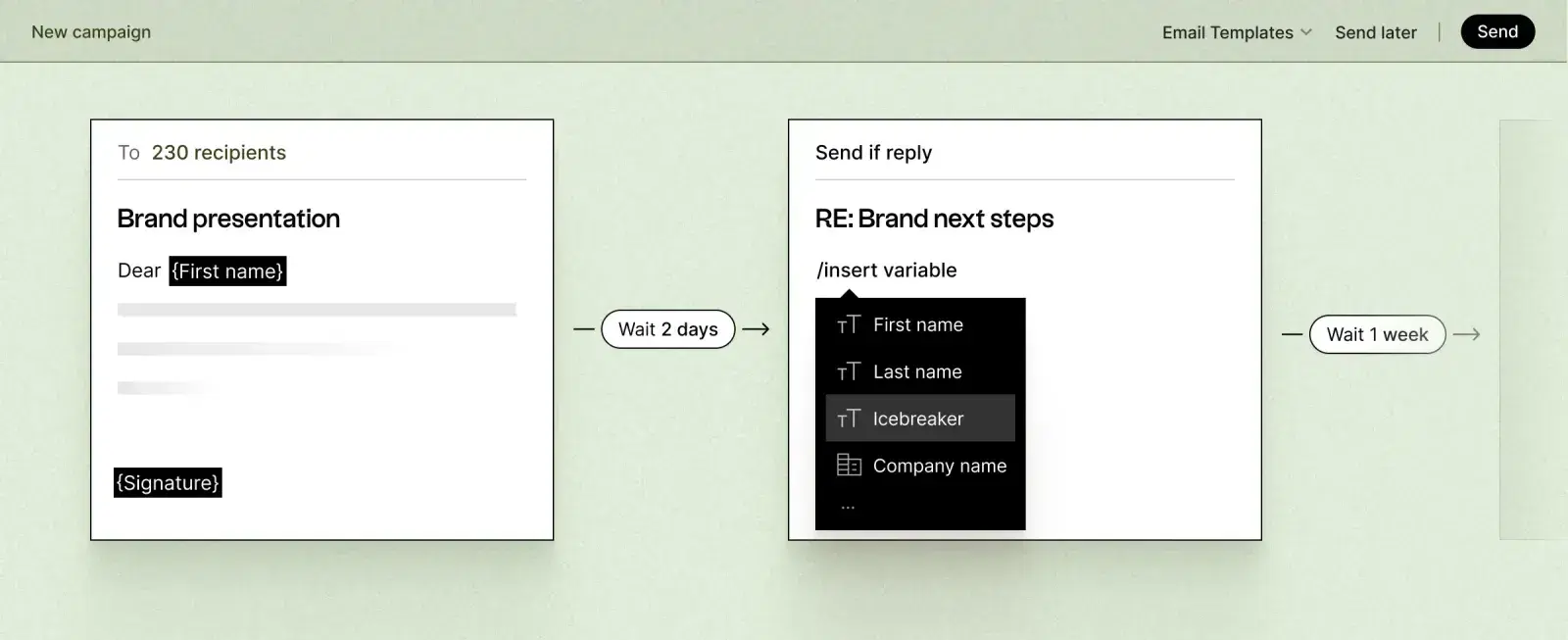
The follow-up sequence
Most HNW prospects don't respond to the first touchpoint. This is normal — they're busy and they're cautious about responding to outreach they don't recognise.
A disciplined follow-up sequence:
- Touch 1: Email with a personalised hook
- Touch 2 (Day 5–7): Brief follow-up referencing the first message
- Touch 3 (Day 10–12): LinkedIn connection or message with a new angle
- Touch 4 (Day 16–18): Final close — respectful, no pressure
Stop at 4 touches. More than that damages your brand with the prospect, and if they haven't responded to four thoughtful touches, the timing is wrong. Mark them for re-engagement in 6 months.
The role of channel in HNW outreach
Still the primary channel for reaching executives. Has the advantage of permanence — they can come back to it when the timing is better. Subject line and first line determine whether it gets read.
Increasingly important for HNW outreach because of the social context it provides. A prospect can look you up, see your content, and assess your credibility before deciding whether to respond. This makes LinkedIn warm up email outreach significantly when both are used together.
Phone
Works for some segments — particularly business owners who are comfortable with direct contact. Rarely works for C-suite executives who have EA-managed calendars. Use only if you have a direct number and strong context for the call.
Referrals and introductions
The highest-converting channel by far. A warm introduction from a trusted mutual contact converts at 5–10x the rate of cold outreach. Building systems to generate more referrals — from clients, from COIs, from professional networks — is the highest-return investment in your prospecting programme.
Events and in-person
High-effort, high-return for certain segments. Worth targeting for the specific niche conferences, exclusive networks, or charity events where your ideal clients concentrate. One relationship built at the right event can be worth more than a year of digital outreach.
Qualification: knowing who's worth pursuing
Not every HNW individual is worth pursuing. Time spent on the wrong prospects is time not spent on the right ones.
Signs of a strong-fit prospect:
- Matches your ICP in terms of wealth source, life stage, and complexity
- Has a clear trigger event (transition, liquidity event, inheritance, recent promotion)
- Is reachable through your existing network or channels
- Has a profile that suggests openness to professional advice
Signs to deprioritise:
- Already deeply embedded with a firm that serves their needs well
- No clear trigger event or reason to consider a change
- Outside your geographic or service scope
- Public signals of dissatisfaction with advisors generally (these conversations are harder to win, not easier)
A shorter list of higher-fit prospects, worked more intensively, will produce better results than a long list of marginal ones.
Common mistakes in HNW prospecting
Leading with credentials. "I have 20 years of experience and manage $X in assets" is about you, not them. The first thing you say should be about their situation.
Generic messaging. A message that could have been sent to 500 people signals to the prospect that you're sending it to 500 people. Personalisation isn't optional at this level.
Pitching the relationship. Saying "I'd love to manage your assets" in an early touchpoint is too much, too soon. HNW individuals choose advisors through a trust-building process, not a pitch.
Following up too aggressively. Four thoughtful touches over 3 weeks is appropriate. Four emails in one week is not. Aggression signals desperation — the last thing that works with this prospect type.
Not following up at all. Equally damaging. Most advisors give up after one or two attempts. Most responses come on touch 3 or 4.
Missing the trigger window. An executive who just announced a liquidity event, received a major promotion, or sold their business is in the market for planning help right now. Slow follow-up on trigger events means losing a prospect to whoever gets there first.
Building a sustainable HNW pipeline
A single successful prospecting effort converts some prospects and loses others. A sustainable pipeline requires ongoing, systematic effort — so there are always new prospects entering, current prospects being nurtured, and conversations happening.
The elements of a sustainable HNW prospecting programme:
- Ongoing list building — continuously adding new qualified prospects based on trigger events and ICP fit
- Systematic outreach — personalised multi-touch sequences for each prospect
- Content presence — LinkedIn content that keeps you visible and credible between outreach attempts
- Referral system — consistent effort to generate introductions from clients and COIs
- Tracking and iteration — monitoring what works, refining messages, improving targeting
This is not a part-time effort. Advisors who build consistent pipelines treat it as a discipline, not a campaign.
If you want to run a high-volume, personalised HNW prospecting programme without building the operational infrastructure yourself, Spaces does it for you — identifying qualified prospects, running personalised multi-channel outreach, and booking meetings directly into your calendar.