How to Re-Engage Stale HNW Prospects with Valora: A Step-by-Step Guide

Bhavya Barot
Stale doesn't mean dead.
Most advisory firms have a CRM full of prospects who expressed genuine interest, had a positive early conversation, and then went quiet. Timing wasn't right. The prospect was mid-transaction. A life event intervened. The follow-up cadence dropped off and the relationship cooled.
Those prospects represent real, recoverable pipeline — if you reach back out at the right moment, with the right message.
The problem is that re-engagement campaigns are exactly the kind of work that never gets done. BD teams are focused on fresh pipeline. Advisors are managing existing clients. Nobody has time to work through a list of 200 contacts who went cold six months ago.
That's the problem Valora solves.
Step 1: Define Your Re-Engagement List
Not every stale prospect deserves a revival campaign. Start by filtering for the ones with the highest potential:
High-priority for re-engagement:
- Prospects who expressed genuine interest but said timing wasn't right
- Prospects who met your ICP and had at least one positive touchpoint
- Prospects who went quiet mid-conversation rather than explicitly disengaging
- Contacts who may have had a recent relevant life event (business sale, executive transition, liquidity event)
Filter out:
- Prospects who explicitly opted out or asked not to be contacted
- Contacts who were clearly outside your ICP
- Anyone whose last interaction included a strong negative signal
CRM filters to use:
- Last contact date: 3–18 months ago
- Engagement score: had at least one positive interaction (reply, call, meeting attended)
- Close reason: timing, not ready, no response (not: unqualified, wrong fit)
Step 2: Enrich Before You Reach Out
Stale outreach fails when it references outdated context. Before Valora sends anything, refresh each prospect's profile.
Valora's enrichment capabilities automatically check:
- Current professional role and firm (job changes are a high-priority trigger)
- Recent company news or events relevant to their wealth situation
- New wealth signals — funding rounds, M&A activity, executive transitions, public disclosures
- Any new behavioral signals from your website or content
A prospect who has changed jobs, experienced a liquidity event, or moved into a new role in the past few months is significantly more likely to re-engage than one whose circumstances haven't changed. Valora surfaces these signals automatically and prioritizes outreach accordingly.
Step 3: Build a Re-Engagement Message Framework
Valora needs to understand how to speak to this audience differently from cold prospects. Create a message framework that:
- Acknowledges the prior relationship briefly ("We connected earlier this year about...")
- Opens with something new — a changed circumstance, a relevant insight, or a new offering
- Avoids the tone of a chase ("Just following up" never works)
- Leads with value: something relevant to their current situation, not just your firm's services
- Has a low-friction ask: a brief call, a relevant resource, a question — not an immediate pitch
What works:
- Referencing a relevant event in their professional life ("Congratulations on [recent news]...")
- Sharing a genuinely relevant insight or market perspective
- A direct, honest acknowledgment: "We spoke a while back and I wanted to reconnect now that..."
What doesn't work:
- Generic "checking in" messages
- Resending the original pitch
- High-pressure asks at the first touchpoint of re-engagement
Step 4: Configure the Valora Campaign
Inside Spaces, set up the re-engagement campaign:
- Upload your filtered re-engagement list with enriched profiles
- Tag contacts with a re-engagement campaign identifier (keeps reporting clean)
- Apply the message framework from Step 3 as the campaign persona
- Set delivery channels — email first, LinkedIn as secondary touchpoint
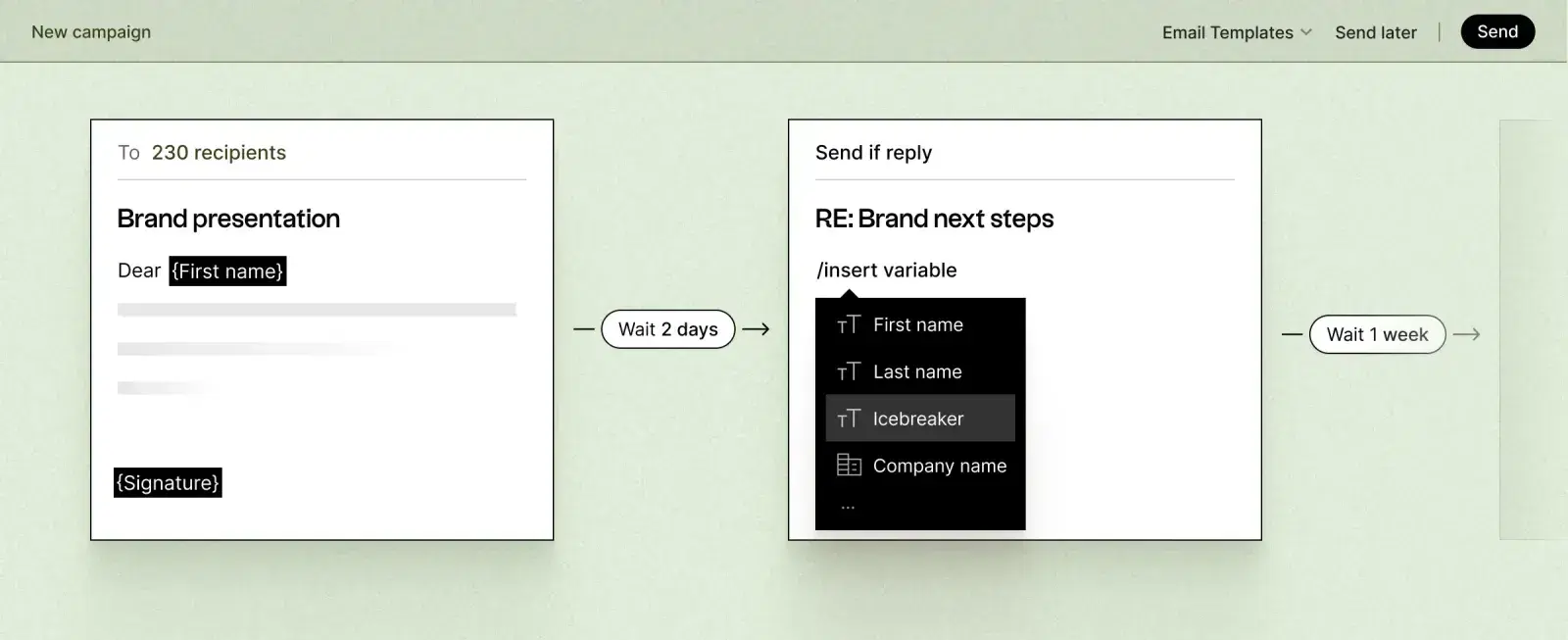
- Set sequence cadence: typically 3–5 touchpoints over 4–6 weeks for re-engagement (less aggressive than cold outreach)
- Configure A/B message variants to test different opening hooks
Valora will personalize each message based on the enriched profile and send it at optimal times based on engagement patterns.
Step 5: Monitor Signals and Qualify Actively
Valora tracks all outreach performance in real time. During the campaign, watch for:
- Direct replies — the clearest signal of re-engagement; route to an advisor immediately
- Click activity from known contacts — strong intent signal, escalate priority
- New contacts engaging from the same firm or family — a positive secondary signal
- Signal-based triggers — job changes, funding events, or hiring activity from the prospect's firm that fire during the campaign window
When strong intent signals appear, flip the prospect's status in your CRM to active and route to a human advisor with full context on the re-engagement conversation.
Step 6: Close the Loop and Refine
After 4–6 weeks, pull conversion metrics:
- Re-engagement rate (replies or meaningful engagement / contacts reached)
- Qualified conversations generated
- Discovery calls booked from the campaign
Segment learnings by the original reason the prospect went cold — timing vs. no response vs. mid-conversation drop-off. Different segments often respond to different messaging approaches.
Update your re-engagement playbook based on what worked. The next campaign will perform better.
Advanced Plays
Layer in prior conversation context. For high-value prospects where you have call notes or detailed conversation history, feed that context into Valora's personalization — so the re-engagement message references specific details from the earlier relationship.
Trigger automatic re-engagement on job change. Configure Valora to automatically initiate a re-engagement sequence when a stale prospect changes jobs or firms. Role transitions are one of the highest-intent moments for advisory conversations.
Schedule systematic quarterly sweeps. Don't treat re-engagement as a one-time campaign. Set Valora to run a re-engagement sweep of prospects who have been inactive for more than 90 days, on a rolling quarterly basis. The pipeline maintains itself.
What You Need to Run This Today
- A CRM with historic prospect records (even incomplete data is a starting point)
- A defined ICP to filter which stale prospects are worth re-engaging
- A clear positioning framework for the current state of your firm and offering
- Valora configured with enrichment and outreach capabilities
Stale pipeline is one of the most underutilized assets most advisory firms have. The prospects were real — they expressed genuine interest once. With the right re-engagement system, many of them will again.
See how Spaces helps RIAs recover stale pipeline with Valora.